

How to Stop Struggling and Start Living
Introduction
Most of us have, at some point, put something off until we felt ready. More confident, less anxious, a bit calmer, and then we’ll do it. In this book, Russ Harris’s The Happiness Trap asks what happens if that feeling never arrives, and whether we actually need it to.
Harris is a doctor turned therapist and trainer, and the book is built on Acceptance and Commitment Therapy (ACT). Harris’s argument is that chasing happiness and fighting the thoughts and feelings that get in its way often leaves us feeling worse. What he suggests instead is making room for those feelings and putting our energy into a life that matters to us.
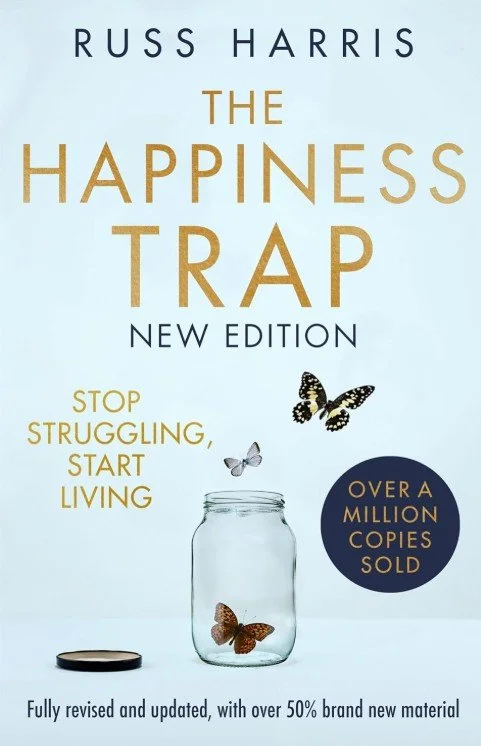
Cover for The Happiness Trap by Russ Harris
The Central Idea
Harris says that the harder we try to control uncomfortable thoughts and feelings, the more space they take up. Self-doubt, fear, disappointment and sadness come with being human, yet we spend huge amounts of energy pushing them away or waiting for them to fade before we do the things we care about.
His alternative is to stop fighting them. That doesn’t mean pretending everything is fine, ignoring your emotions or putting up with situations that need to change. It means accepting that you don’t have to sort out what’s going on inside you before you act. You can feel unsure and still make the decision. You can feel afraid and still take the step.
Harris describes four common beliefs about happiness:
1. That it’s our natural state.
2. That if we’re not happy, something must be wrong with us.
3. That we have to get rid of negative feelings to live well.
4. That we ought to be able to control what we think and feel.
Wanting to feel good is perfectly natural, but it becomes a problem when feeling good turns into the condition for living a good life.
You can probably hear it in your own head: I’ll do it when I’m more confident. I’ll make the change when I’m less afraid. I’ll enjoy life more when things settle down. Meanwhile, the conversation goes unspoken, and the change stays on the list.
For me, this is one of the most important ideas in intentional living. We may not be able to control every thought, feeling or circumstance, but we can become more conscious of how we respond. And that awareness gives us a little more room to choose.
We can’t control every feeling or everything that happens around us, but we can become more aware of how we respond.
Our Thoughts Aren’t Always Facts
One of the most useful ideas in the book is that we don’t have to treat every thought as the truth. Our minds are always interpreting and predicting, and a lot of what they tell us comes from old experiences, assumptions and fears: I’m not capable enough. It’s too late to change direction. People will be disappointed in me. If we believe those thoughts without question, they quietly steer how we live.
In Acceptance and Commitment Therapy (ACT), this is known as cognitive defusion. Rather than trying to silence our thoughts or argue with them, we learn to notice them for what they are: thoughts, not necessarily facts. We can acknowledge them without letting them automatically dictate what we do.
There’s a difference between “I can’t do this” and “I’m having the thought that I can’t do this.” The thought may still be there, but it stops being the final word.
Living According to Our Values
This is the part of the book that speaks most directly to this month’s theme of values.
Harris separates chasing happiness as a feeling from building a life that reflects what matters to you.
Values, in this sense, aren’t a list of things we say are important. They’re how we choose to behave, the relationships we put time into, and the kind of person we want to be, but there's often a gap between what we say matters and what our everyday lives actually reflect.
We value connection but get too busy to see the people we love.
We value wellbeing but put our own needs last.
We value honesty but agree to things that don’t feel right because we don’t want to let someone down.
Noticing that gap isn’t a reason to criticise yourself.
It’s useful information about whether your choices reflect the life you want, and you don’t need perfect circumstances or a sudden burst of confidence to start closing it. Small actions count, and when we drift, we can realign.
What Stood Out for Me
What stayed with me most is the idea that personal growth doesn't have to mean fixing everything we find uncomfortable about ourselves. We can spend so much time trying to become a better version of ourselves that we forget to live with the person we already are.
It also invites some honest questions.
Am I making this choice because it reflects what matters to me, or because it helps me avoid discomfort? Am I saying yes because I want to, or because I’m afraid of how someone will react if I say no? Those aren’t comfortable questions, but they show where habit, fear or expectation is making decisions that we think we’re making consciously.
Who Is It For?
I’d recommend The Happiness Trap if you:
• Get caught in cycles of overthinking or self-doubt
• Spend a lot of energy trying to control how you feel
• Put off decisions until you feel more confident
• Are questioning whether your everyday choices reflect your values
• Are going through change or a new chapter and want a practical approach to growth that doesn’t demand perfection
The book is practical rather than purely philosophical, with exercises that encourage you to reflect and practise the ideas for yourself. After all, understanding something intellectually is one thing; responding differently when life gets difficult is another.
Key Takeaways
• Happiness isn’t a prerequisite for a good life. You can have difficult emotions and still build a meaningful life.
• Not every thought deserves your belief. Noticing a thought is the first step to responding to it more consciously.
• Avoiding discomfort has a cost. The things we dodge are often closest to what matters most.
• Values can guide you when feelings can’t. You don’t have to wait until you feel ready to take a step.
• Small, everyday actions matter more than good intentions.
Final Thoughts
The most useful question I took from The Happiness Trap is not “What would make me happier?” but “What kind of life do I want to be living, and what matters enough for me to take a step towards it?”
We all want happiness and comfort, but when we make those feelings a condition for living well, we risk spending too much of our lives waiting for the right moment.
For me, this is where the book connects with the heart of Remember • Rewrite • Live: reconnecting with ourselves, questioning the stories that hold us back, and putting what matters into practice through the choices we make.
We don't have to feel ready, have everything figured out or get it right every time. We can begin with the next small choice.
If you would like to explore the book yourself, you can find it here: The Happiness Trap.
(Affiliate links are for Amazon UK only — if you choose to purchase through them, it costs you nothing extra and helps support my work – with thanks.)